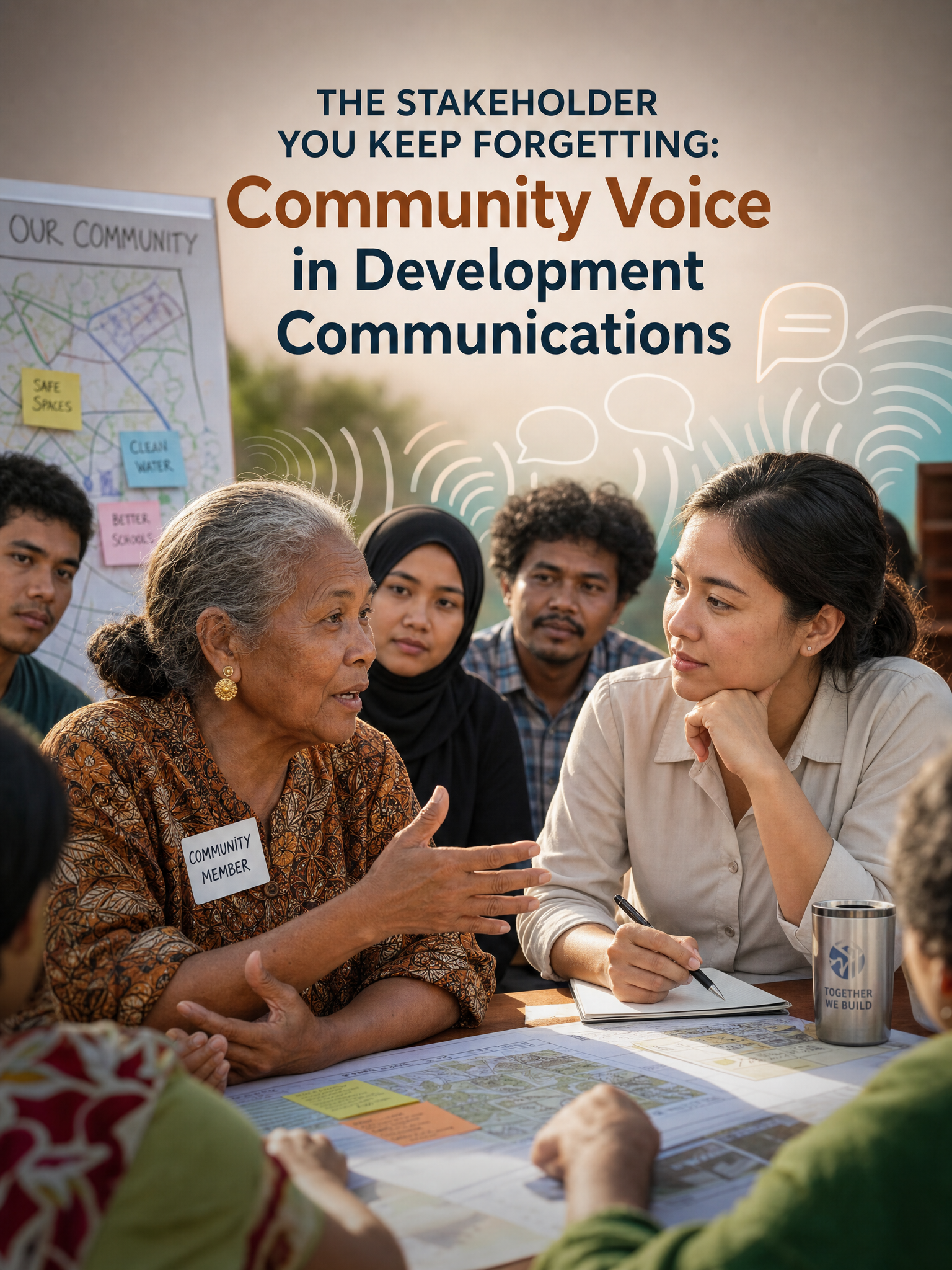

Most development programmes in Ghana can show you a theory of change. Very few can show you the communication strategy within it. The gap between the two is where programmes quietly lose the communities they were designed to serve.
A theory of change states what you expect to happen. A communication strategy states how the people involved will come to understand, trust and act on it.
Communication treated as reporting produces events, materials and media placements. It does not produce the trust that decides whether outcomes happen.
The test is simple. Ask whether your log frame contains a single indicator about what the community understands.
Closing the gap is a design decision taken before implementation, not a communications hire made halfway through.
The document everybody has
Walk into any programme office in Accra and ask for the theory of change. You will get it within a minute. It will be well constructed. Inputs, activities, outputs, outcomes, and impact. They are assumptions listed on the side. Someone worked hard on it.
Now ask for the communications strategy. You will get one of three answers. There is a communications officer who handles it. There is a visibility plan in the donor agreement. Or the honest one: nobody has written it down.
The theory of change says a behaviour will shift. The communication strategy is the only document that explains how the people expected to shift it will come to understand, trust and act on what you are proposing. Without it, the theory of change is a statement of hope with a budget attached.
What goes in the gap?
Programmes do not fail loudly. They underperform quietly, and the explanations offered afterwards tend to fall into the same small set. The community was not ready. There was resistance. Uptake was slower than projected. Cultural factors.
Each of those is a communication finding wearing a different coat. Communities were not ready because no one had established what they already believed. Resistance appeared because the programme arrived with an answer before asking a question. Uptake was slow because the message reached people through a channel they did not trust.
None of these is not a failure of effort. They are failures of sequence. The communication work that would have surfaced them happens after design is locked, when it has been reduced to explaining a decision rather than informing it.
Communication as a reporting function
Most development programmes in Ghana treat communication as something that happens to a programme rather than as something that shapes it. The function produces events, materials and media placements. It reports upwards to the funder. It rarely reports inwards to the design.
You can see this in where communication sits on the organogram and when it gets involved. If the communications lead joins at inception, communication is a design input. If they join at launch, communication is packaging.
The budget tells the same story. A line for visibility materials and a line for an event are part of a production budget. A line for community intelligence before the first meeting is part of a strategy budget. Most programmes include the first but not the second.
A test you can run this week
Open your log frame. Count the indicators that measure what the community understands, believes or trusts. Not attendance. Not materials distributed. Not reach. Understanding.
In most programmes, the count is zero. Everything measured sits on the delivery side of the relationship. Nothing measures whether the relationship exists.
This matters because what you do not measure, you cannot manage. A programme that counts attendance will optimise for attendance. People will come. That tells you very little about whether anything changed when they went home.
- Who decided on those channels, and on what evidence?
- Does any indicator capture community understanding rather than programme output?
- Did anyone map what the community already believed before the design was finalised?
- Can you name the three most trusted information channels in your target community?
What closing the gap looks like
The correction is not a large communications budget. It is an earlier one.
Diagnostic work comes before design. That means mapping authority structures, historical trust levels, existing beliefs about the subject, and the channels communities use, before the first community meeting, rather than after the first sign of resistance.
Design then responds to what the diagnostic found. If the community’s decision-making about a health behaviour is governed by a belief the programme has never addressed, the campaign addresses that belief. If the trusted messenger is not the one in the budget, the budget is adjusted.
A theory of change tells you what should happen. A communication strategy tells you why anyone would let it.
Delivery and measurement follow. The measurement includes understanding, not only output. That gives the programme something to adapt to while there is still time.
The uncomfortable part
Doing this properly means accepting that the diagnostic may change the design. That is the point, and it is also why it rarely happens. By the time most programmes have a budget, the design is in the proposal, the proposal is in the contract, and the contract is signed.
That is an argument for conducting the diagnostic earlier, still at the proposal stage, when costs are low, and the design is still soft. Development budgets routinely include a line for stakeholder and social mapping at inception. The money is often already there. It is the sequence that is wrong, not the funding.
Common Questions
What is a development communication strategy?
A development communication strategy sets out how the people a programme aims to serve will come to understand, trust and act on its proposals. It covers the audiences, the existing beliefs the programme must address, the channels those audiences trust, the messengers who carry authority, the behaviour change sought, and how understanding will be measured. It sits within the theory of change rather than alongside it.
How is it different from a visibility plan?
A visibility plan meets a funder’s branding and reporting requirements. It covers logos, materials, events and media placements. A communication strategy assesses whether the community understands and trusts the programme. Both are necessary. Only one of them determines whether the programme works.
When should the communication strategy be written?
Before the programme design is fixed, diagnostic work that surfaces community beliefs and trust levels only has value while the design can still respond to them. Written after the design, a communication strategy can explain decisions but cannot improve them.
How do I know whether my programme has this problem?
Open the log frame and count the indicators that measure community understanding rather than programme outputs. If the count is zero, the programme is measuring delivery and assuming trust.